
Sacred & Spiritual Lands
Uluru, Australia: The Red Earth That Teaches Reverence

Marcia Yateman
August 20, 2026
Uluru doesn't ask you to visit — it asks you to arrive differently. The red earth of central Australia teaches reverence, patience, and the quiet power of boundaries. Some places change us not by what we do there, but by what we learn to honor.
Dear Sacred Travelers,
You don’t arrive at Uluru simply as a visitor.
You arrive as someone entering a place that has been listening for a very long time.
Rising from the red earth of central Australia, Uluru is often described as a landmark, a monolith, or one of the country’s most recognizable natural wonders. But these descriptions can make the place feel smaller than it is. Uluru is not merely something to look at. It is a presence—a vast, weathered formation carrying layers of geological, cultural, and spiritual significance.
For the Anangu people, the Traditional Custodians of the land, Uluru is a deeply sacred place connected to Tjukurpa—the foundational stories, laws, relationships, and responsibilities that shape life and culture. The landscape is not separate from those stories. Its caves, waterholes, markings, and paths are part of a living map of knowledge.
To stand before Uluru is to encounter a different understanding of time.
The rock does not hurry. It does not perform. It does not need to prove its importance. It simply remains—changing color with the movement of the sun, holding the heat of the day, and receiving the coolness of the night.
Perhaps this is one of the first lessons Uluru offers: importance does not always announce itself loudly.
A place that asks for respect
Sacred places are not attractions in the ordinary sense. They are not empty backdrops waiting to become our personal experiences. They belong to histories, communities, ceremonies, and relationships that existed long before we arrived.
This is why visiting Uluru asks something of us beyond admiration. It asks us to become respectful guests.
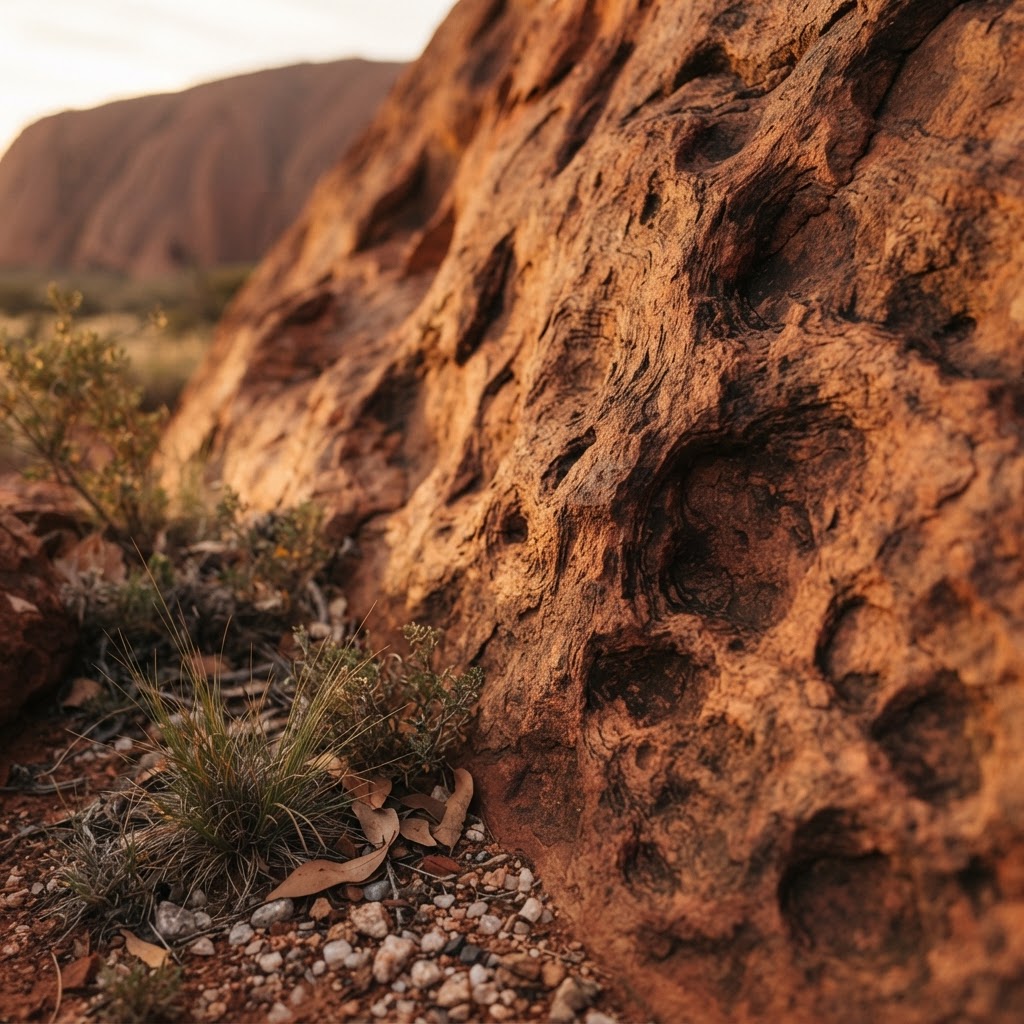
The traditional climb of Uluru was permanently closed in 2019, honoring the wishes of the Anangu people. That closure offers a meaningful reminder: sometimes reverence means accepting a boundary. Sometimes the most respectful way to approach a sacred place is not to conquer it, climb it, or possess it—but to listen.
In a culture that often confuses access with entitlement, this can be a profound spiritual teaching.
Not everything beautiful is ours to enter.
Not everything powerful is ours to touch.
Not every experience needs to be claimed in order to change us.
The healing power of red earth
Uluru’s color shifts throughout the day. In the soft light of morning, it may appear muted and rose-colored. At sunset, it can deepen into copper, crimson, or burnished gold. The transformation is gradual, almost imperceptible, until suddenly the entire formation seems to be glowing from within.
Watching this change can bring you into a quieter relationship with time.
There is no need to rush toward the next view. No need to fill every pause with conversation. The landscape is already doing something. It is revealing that change can be slow and still be dramatic.
Many of us move through life believing that healing should be obvious. We expect a breakthrough, a revelation, a moment when everything becomes clear. But much of the deepest healing happens more like the changing light on Uluru: gradually, silently, and through a process we cannot force.
You may not notice yourself becoming more grounded from one day to the next. You may not feel your nervous system learning safety in real time. But then, one evening, you realize you are no longer reacting to life in quite the same way.
Something has softened.
Something has settled.
Something within you has begun to glow.
Listening instead of collecting
A journey to Uluru is not about collecting an impressive image or proving that you have been somewhere extraordinary. The deeper invitation is to practice presence.
Sit quietly, if you are able. Notice the texture of the earth. Observe the changing sky. Listen to the wind moving across the open land. Let the silence be more than an absence of sound. Let it become a form of communication.
Ask yourself:
- What am I trying to rush?
- Where in my life have I mistaken control for safety?
- What would it mean to approach the world with greater humility?
- Which boundaries am I being asked to respect?
- What has been changing in me, even if I have not yet recognized it?
You do not need to answer immediately. Sacred places often work beneath the level of language.
Bringing Uluru home
Most of us will not be able to travel to Uluru. But the qualities it awakens—reverence, patience, humility, and groundedness—can be practiced anywhere.
You can begin by spending a few minutes each day with something older and quieter than your thoughts: a tree, a stone, a horizon, the morning sky. You can create a small ritual of looking without photographing, listening without interrupting, and being present without needing to produce anything.
You can also ask where you have been taking too much—too much attention, too much certainty, too much control—and where you might instead practice reciprocity.
Uluru reminds us that the earth is not simply scenery for our lives.
It is teacher, ancestor, witness, and home.
And sometimes the most healing thing a place can do is return us to a sense of scale: reminding us that we are small, that we are connected, and that being small does not make us insignificant.
It makes us part of something much larger.
Reflection
Place one hand over your heart and one hand over your abdomen. Take a slow breath and imagine yourself standing before a vast red landscape.
Say quietly:
I do not need to possess what I revere.
I can listen.
I can move with humility.
I can allow time to change me.
Then remain still for a few breaths.
Let the earth be more than a destination.
Let it be an invitation.
August 31
The Marfa Lights, Texas: Where the Desert Refuses to Explain Itself
Category: Earth Mysteries & Anomalies
There are places that answer your questions.
And then there are places that make better questions possible.
In the high desert of west Texas, near the small town of Marfa, mysterious lights have been reported for generations. They appear in the distance—sometimes white, sometimes orange, red, or blue—hovering, flickering, dividing, merging, or disappearing without warning.
Some observers believe the lights are caused by distant vehicle headlights refracted through the atmosphere. Others point to campfires, atmospheric conditions, or optical illusions. And yet, even when explanations are offered, the fascination remains.
Because mystery is not always destroyed by understanding.
Sometimes it becomes more interesting.
The desert as a threshold
The desert changes your relationship with distance.
In a city, the world is crowded with signals. Buildings interrupt the horizon. Streetlights soften the darkness. Sound is constantly arriving from somewhere. The mind is given very little room to wonder.
In the desert, distance becomes immense. A point of light may be close or impossibly far away. A mountain can look near for hours and remain unreachable. The horizon stretches beyond the limits of ordinary attention.
This uncertainty can be unsettling at first.
We are accustomed to identifying things quickly. We want to know what we are seeing, where it came from, and what it means. But the Marfa Lights resist immediate interpretation. They ask us to remain with an experience before deciding what it is.
That is a rare kind of discipline.
The discomfort of not knowing
Many emotional struggles are intensified by our demand for certainty.
We want to know whether someone will stay. Whether a decision is correct. Whether healing is working. Whether the future will unfold safely. When answers do not arrive, the mind often creates them—sometimes inventing the most painful explanation simply to end the uncertainty.
The Marfa Lights offer another possibility: not knowing does not always mean something is wrong.
Sometimes uncertainty is simply a space that has not yet revealed its shape.
Standing beneath the wide Texas sky, watching a distant glow appear and vanish, you may feel the mind reaching for closure. You may notice how quickly you label what you cannot explain. You may realize that the desire for an answer is not always the same as the presence of truth.
The light is there.
Your interpretation is something else.
Wonder without certainty
Wonder does not require belief in the supernatural. It does not ask you to reject science or accept every mysterious story as fact. Wonder simply allows the world to remain larger than your current understanding.
This is important emotional work.
When we believe we already know everything about a situation, we stop listening. We stop noticing. We become attached to our first interpretation and defend it as if it were reality itself.
But there is a difference between truth and the story we create around an experience.
A distant light may be a reflection, a vehicle, a weather phenomenon, or something still not fully understood. The wisdom may not lie in choosing one explanation prematurely. It may lie in developing the capacity to observe carefully while remaining open.
That capacity can change the way we relate to ourselves and to other people.
What the lights illuminate within us
Mysteries often reveal more about the observer than the object.
One person sees the lights and feels excitement. Another feels fear. Someone else feels comfort, as if the desert is sending a message. The same phenomenon becomes a different emotional experience depending on what each person brings to it.
This makes the Marfa Lights an unexpected mirror.
Ask yourself:
- What do I do when I cannot control the outcome?
- Do I become curious, anxious, avoidant, or controlling?
- Which explanations do I reach for most quickly?
- Can I separate what I know from what I assume?
- Where in my life might uncertainty be inviting patience rather than panic?
These questions are not meant to eliminate fear. They are meant to create space around it.
You do not have to force yourself to enjoy uncertainty. You can simply learn to meet it without immediately abandoning yourself.
A practice for the unknown
The next time you feel caught in an unanswered question, try this simple practice.
First, name the facts without interpretation.
For example:
- “I have not received a response.”
- “The decision has not been made.”
- “I do not yet know what will happen.”
Then name the story your mind is adding:
- “They must be angry.”
- “I am going to fail.”
- “This will never change.”
Finally, create a third sentence that leaves room for reality:
“There is more here than I know right now.”
This is not denial. It is emotional spaciousness.
It allows you to stay connected to what is real without allowing fear to become the author of the entire story.
The gift of a place without closure
The Marfa Lights do not need to be solved in order to be meaningful.
Their value may be found in the way they interrupt certainty, draw attention toward the horizon, and remind us that the world contains more possibilities than the mind can organize.
Some places heal us by making us feel held.
Others heal us by shaking us awake.
The Marfa desert does both. It strips away distraction and leaves you face-to-face with the unknown. It asks you to stand beneath a sky large enough to hold your questions without rushing to answer them.
Perhaps that is the deeper mystery:
Not what the lights are, but what becomes possible when we stop demanding that everything reveal itself immediately.
Reflection
Find a quiet place and look toward the farthest point you can see. Allow your gaze to rest there without searching for anything specific.
Breathe slowly and repeat:
I can be present without having every answer.
I can observe without immediately deciding.
I can trust myself to meet what is revealed in time.
Let the unknown remain unknown for a little longer.
Sometimes clarity does not arrive because we have solved the mystery.
Sometimes it arrives because we have become spacious enough to live beside it.