Sacred Sites
Sacred Sites of Stillness: A Pilgrimage Through the Inner Landscape

Marcia Yateman
October 1, 2026· 10 min read
From hermit caves to stone circles, the world's quietest sacred places mirror the terrain of our own healing — and offer a map for returning, again and again, to ourselves.
There is a particular quality of silence that exists only in certain places on earth. It lives in the worn stone steps of a mountain monastery, in the cool dark of a hermit's cave, in the endless hush of desert sand, in the ancient circle of standing stones where the wind seems to remember something the rest of us have forgotten. These places do not simply offer quiet. They offer a mirror — a physical geography that reflects back to us the shape of our own inner landscape.
This is the premise of the pilgrimage, and it is the premise of healing itself: that the outer journey and the inner one are never truly separate. When we walk toward a sacred site, we are also walking toward some unmet part of ourselves. When we sit in stillness within ancient walls, we are practicing the same stillness we are so often starved of within our own minds.
This quarter, we travel — not for leisure, but for understanding — through five sacred landscapes of stillness: the hermit's cave, the desert retreat, the monastery, the stone circle, and the quality of silence that holds them all together. Each one speaks to a different layer of the healing journey. Let this be less an itinerary and more an invitation — to notice where your own soul has already been standing, waiting for you to arrive.
The Hermit's Cave: Where Grief Learns to Breathe
Scattered across the cliffs of places like Cappadocia, the Himalayan foothills, and the rocky coasts of Ireland are small, hollowed-out caves where hermits once lived — sometimes for years, sometimes for a lifetime — in near-total solitude. These were not places of punishment. They were places of devotion. A hermit's cave is small by design. It does not accommodate distraction. It holds only what is essential: a body, a breath, and whatever truth that body has come there to face.
There is something in us that recognizes this kind of space immediately, even if we have never set foot in one. It is the same instinct that makes us want to close the bedroom door after a loss, to turn inward rather than outward when grief arrives. Grief does not want an audience. It wants a cave.
We live in a culture that often mistakes withdrawal for weakness, that rushes grief toward resolution before it has finished its slow, necessary work. But the hermit's cave teaches something gentler: that solitude is not the absence of healing — it is often the very condition that allows healing to occur. In the dark, quiet smallness of the cave, there is nowhere to perform. There is only the self, finally unwitnessed, finally free to feel what it feels.
Grief does not ask to be fixed. It asks to be witnessed — and sometimes the only witness it can bear, at first, is the dark.
If you have ever found yourself craving isolation after a loss — a breakup, a death, the quiet ending of a version of yourself — you were not regressing. You were instinctively building your own hermit's cave: a small, safe enclosure in which grief could finally breathe without needing to explain itself to anyone.
The Desert: Where We Learn to Be Emptied
Long before deserts became symbols of isolation in literature, they were considered sacred thresholds — places where mystics and seekers went not to find something, but to be emptied of everything that was no longer true. The Desert Fathers of early Christianity, the Sufi ascetics of the Middle East, the vision-questers of Indigenous traditions across the American Southwest — all understood the desert as a place where the self is stripped down to its barest, most honest form.
There is little in the desert to hold onto. No shade, no softness, no distraction from the vastness of sky and silence. And yet it is precisely this austerity that makes the desert so transformative. When there is nothing external to lean on, we are forced to meet what is internal — our fears, our attachments, the stories we have been telling ourselves simply to avoid the discomfort of empty space.
This is, in many ways, the emotional landscape of renewal. Before we can become something new, we often have to pass through a kind of inner desert — a season where old identities fall away and nothing has yet risen to replace them. It is disorienting. It can feel, at times, like nothing at all is happening. But renewal rarely announces itself. It moves the way sand moves: slowly, invisibly, reshaping the whole terrain before we notice the dune has shifted.
If you are in a season that feels empty, directionless, or strangely quiet after a long period of striving, you may not be lost. You may simply be in the desert — doing the slow, sacred work of being emptied before you are filled again.
The Monastery: Where Surrender Becomes Structure
Monasteries — whether Buddhist, Christian, or otherwise — are built around rhythm. Bells mark the hours. Meals are shared in silence. Prayer and work and rest unfold in a predictable, unhurried sequence that asks nothing of the practitioner except presence. There is a profound relief in this kind of structure, because it removes the burden of constant decision-making and replaces it with devotion to a simple, repeating pattern.
What the monastery offers, more than anything, is a model of surrender that does not require collapse. Surrender, in our culture, is often mistaken for giving up — a kind of defeat. But the monastic life reveals something different: surrender as devotion, as the conscious decision to stop fighting the current and instead move with it, trusting that the rhythm itself is wise.
This is a lesson many of us resist fiercely in our healing journeys. We want to control the timeline of our own transformation — to will ourselves into peace, to muscle our way toward wholeness through sheer determination. But the body does not heal on command, any more than a monk's devotion deepens through force. It happens, instead, through rhythm. Through the quiet repetition of small, sacred practices, returned to again and again, long after the initial inspiration has faded.
Healing is less like a single breakthrough and more like a bell rung at the same hour, every day, calling you gently back to yourself.
This is where many of our NLP-informed coaching tools find their quiet power — not as shortcuts or forceful interventions, but as small rhythmic practices: an anchoring breath, a reframe repeated until it becomes belief, a body-based check-in woven into the architecture of an ordinary day. These tools are not a replacement for the deeper, often longer work of therapy, especially where trauma runs deep — but they can offer the kind of structure a monastery offers: not control, but containment. Not force, but faithful repetition.
The Stone Circle: Where We Remember We Belong
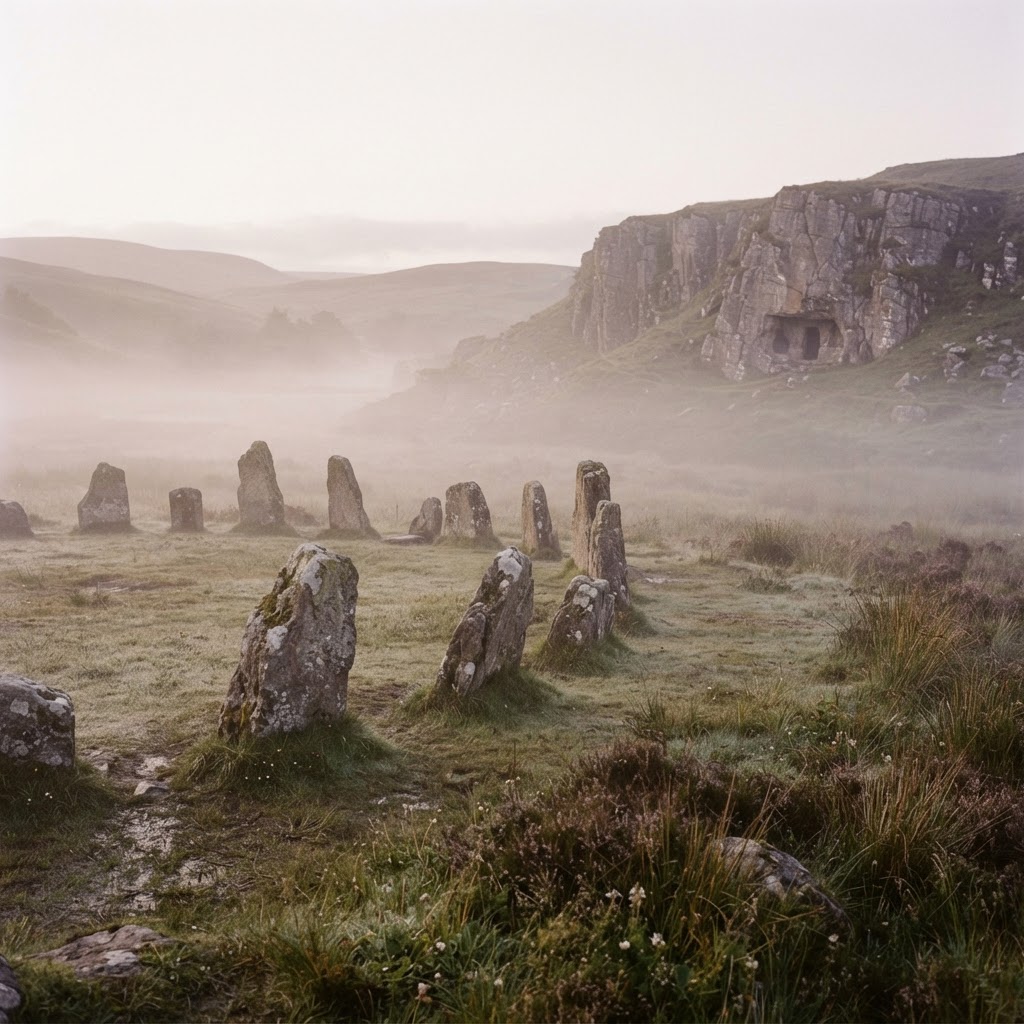
Scattered across the British Isles and parts of Northern Europe are the stone circles — Avebury, Callanish, and of course, the most famous among them — structures so old that even the people who study them most closely can only theorize about their original purpose. What we do know is that they were almost certainly gathering places: sites of ritual, of marking time, of coming together under open sky in community with one another and with something larger.
There is a particular ache that stone circles seem to address, even now, thousands of years later — the ache of disconnection. To stand within a circle of ancient stones, worn smooth by centuries of wind and rain, is to feel suddenly, viscerally, part of a much longer lineage of human beings who also stood beneath an open sky, also searched for meaning, also needed one another.
In our healing work, connection often gets framed as something we either have or lack — a static trait rather than a living practice. But the stone circle suggests something different: that belonging is built through ritual, through gathering, through the simple, repeated act of showing up in circle with others, again and again, until the pattern of our lives becomes a kind of shelter in itself.
If you find yourself longing for connection but unsure how to build it, the stones offer a quiet instruction: it rarely begins with a single, perfect moment of intimacy. It begins with returning to the same circle, the same people, the same practice, until belonging becomes less an event and more a rhythm you can trust.
The Space Beneath It All: Silence as the Original Sacred Site
Underneath every monastery, every cave, every desert and stone circle, there is a single unifying quality: silence. Not the silence of absence, but the silence of attention — the kind that exists when a space has been deliberately kept open, uncluttered, free from the noise that so often fills our days simply because we are afraid of what we might hear if it stopped.
This is, perhaps, the most universal sacred site of all — and the hardest one to visit, because it requires no travel at all. It asks only that we stop. That we sit in the quiet long enough for our own inner voice, so often drowned out, to finally speak.
Many of us arrange our lives specifically to avoid this kind of stillness. We fill the car with podcasts, the evening with screens, the silence between thoughts with more thoughts. Not because we are shallow or avoidant, but because silence often ushers in exactly what we have been too busy to feel — grief, longing, tenderness, the ache of our own unmet needs. Sacred sites of silence do not create these feelings. They simply remove the noise that has been keeping them at bay.
This is not a comfortable kind of stillness, at least not at first. But it is, almost always, the doorway to everything else — the cave, the desert, the rhythm, the circle. Silence is the ground from which all the other sacred landscapes grow.
Visiting These Places Within
You do not need a passport to access the healing quality of these sacred sites. Each one lives, in miniature, inside your own body and daily rhythm — waiting to be visited, again and again, as often as you need.
Build your own hermit's cave. When grief or overwhelm arises, create a small, enclosed physical space — a corner, a closet, a nest of blankets — and sit inside it for ten uninterrupted minutes. Dim the light. Place a hand on your chest or stomach. Let there be nowhere to perform and no one to explain yourself to. Simply allow whatever feeling has been waiting to finally take up space.
Practice a desert pause. Once a day, find five minutes where you do nothing at all — no phone, no task, no input. Let yourself feel the discomfort of empty space without immediately filling it. Notice what rises when there is nothing to distract you. This is not idleness. It is the slow, sacred emptying that precedes renewal.
Create a monastery bell. Choose one small, repeatable ritual — three conscious breaths before you check your phone, a hand on your heart before you eat, a single sentence of gratitude before bed — and return to it at the same moment each day, regardless of how you feel. Let the rhythm itself become the container, the way a bell calls monks back to presence long after motivation has faded.
These are, of course, NLP-informed coaching tools — small, body-based practices designed to interrupt old patterns and anchor new ones. They are not therapy, and they are not meant to replace the deeper support a skilled therapist can offer, especially when grief or trauma runs wide and old. But they can offer something a sacred site often offers the weary pilgrim: not a cure, but a resting place. Not an answer, but enough stillness to finally hear the question.
Wherever you are in your own healing journey — in the cave, in the desert, in the rhythm, in the circle, or simply in the silence beneath it all — know that you have not wandered off the path. You are walking it exactly as it was meant to be walked: slowly, imperfectly, and always, eventually, back toward yourself.
Partner Spotlight
Your brand aligns with a community of emotional healing seekers. Partner with The Emotional Alchemist.
Become a Partner →The Alchemist's Letter
New essays on emotional healing, delivered monthly. No noise — just the work.